 Infotel, là où vous êtes
What are AI hallucinations and how do you prevent them?
What are AI hallucinations and how do you prevent them?

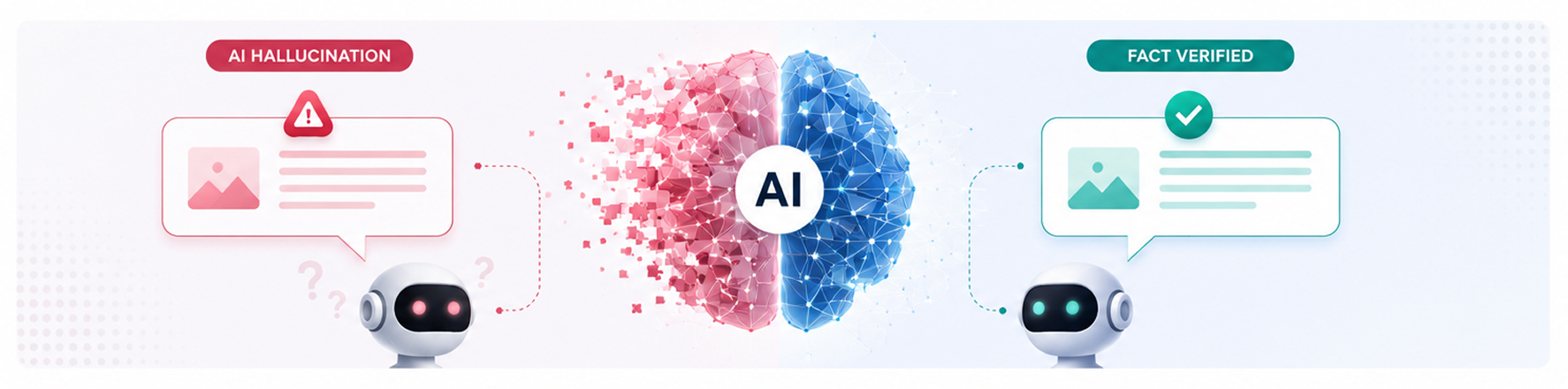
An AI hallucination, also termed confabulation, occurs when a generative AI model confidently presents fabricated information as a fact. AI hallucinations act as a main barrier between an exciting demo and a proper system an enterprise can trust in production.
Generative AI models are trained to generate outputs that look legitimate, but they aren’t. Text-based LLMs are trained to generate the next token in a sequence based on patterns in massive text corpora. When information is sparse or ambiguous, these models might create confabulations.
Why do AI Hallucinations occur?
It might sound simple; a generative AI does not know what is true or false, and it only knows what fits the pattern. The tools generate outputs by predicting which token is next in the sequence based on a previous context. This process is a statistical pattern-matching exercise, and the model generates as per probability within the pattern, not for correctness of the context.
Flawed or Insufficient Training Data
AI models learn from the data that they receive on a regular basis, so any flaws in the data become flaws in the model behavior. If there are factual errors, biases or gaps, the model thinks of acceptable patterns and learns from them. It can’t determine which patterns are accurate and which ones are artifacts of noisy or problematic data.
Statistical Pattern Matching Without Understanding
Since AI models predict the next token based on patterns in training data, they excel at pattern recognition but struggle with issues that require genuine, logical deduction. There are no appropriate ethical guidelines, scientific accuracy, or legal validity which are encoded into AI models; hence, they produce text that sounds right but fails to meet the above criteria. Even with further refinement and alignment procedures, AI models might encounter prompts that they weren’t trained for, leaving room for unexpected outputs.
Adversarial Attacks and Malicious Inputs
Adversarial and malicious inputs lead Gen AI models to produce misleading outputs, hallucinating them while exploiting their learned patterns.
Prompt injection is one type of adversarial input where the attacker tries to inject new data into the model’s context to override the safety configurations. This would lead to ignoring safety policies and create a hallucinating output for the users.
Risks of AI Hallucinations
According to Gartner AI hallucinations compromises both decision-making and organization reputation. As the major risks occurs in decision-making or misinformation where customers, employees, and partners receive inaccurate information that may cause delays and incorrect operational decisions.
Legal and compliance risks are even more serious when AI systems offer incorrect regulatory guidance or inaccurate compliance reports, which may lead to reputational damage to the organisation. They may also face audit failures and penalties. Some of the major risks involved include:
- Reputational damage
- Compliance violations
- Financial losses
- Poor decision-making
- Customer dissatisfaction
- Internal workflow disruption

Types of AI Hallucinations
Factual Hallucinations: They are the most visible and easiest to identify. These occur when a model generates information that is objectively false and it includes incorrect numbers, incorrect dates, invented features, or incorrect technical details.
In case of documentation, tutorials, and technical guidance factual hallucinations quickly removes trust.
Source and Citation Hallucinations: Source and Citation Hallucinations occurs when the model discovers a source, legal case, policy sections, research paper or document that does not exist.
Summary Hallucinations: This happens when AI model summarizes a document but adds details that aren’t valid or misses important conditions. This could be especially risky in enterprise workflows when team rely on AI for internal documentation, compliance analysis etc.
Reasoning Hallucinations: The AI model follows an incorrect logical path and arrive at a confident but an incorrect conclusion often in financial or strategic recommendations, risk scoring, and operational planning.
Preventing AI Hallucinations
Enterprises rely on various practices and strategies to mitigate AI hallucinations.
a. RAG (Retrieval Augmented Generation) Implementation
RAG is an AI framework that improves large language models by connecting them to curated knowledge bases. This eliminates the inaccurate or incorrect outputs and thereby mitigates the hallucinations.
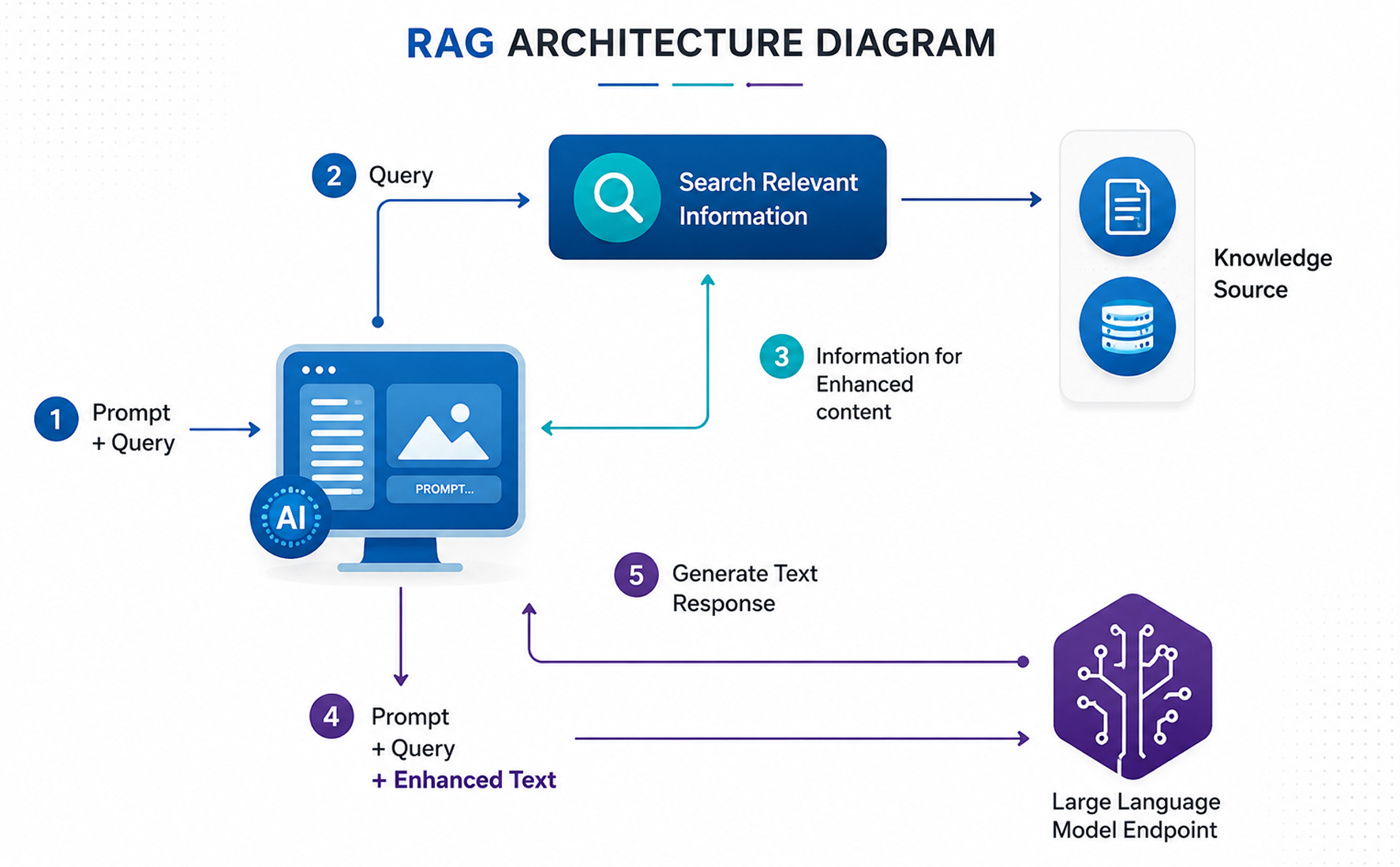
When a user asks a question, a RAG-enabled system searches its curated knowledge source (documents, databases, APIs) for the most relevant items and returns that information, often with citations or quotations.
How RAG Works
RAG is a three-step process that combines Retrieve, Augment, and Generate.
Retrieve : When a user enters a query, the RAG system first searches a knowledge base for relevant and authentic information. It uses two different search methods to ensure accuracy.
Semantic Search, where it finds documents based on the query, even if the exact words aren’t given.
Keyword Search finds documents based on an exact search term which is critical for programming languages.
Augment: From the retrieval step, the system takes the original query and the most relevant documents, where this combined information forms a much richer context for the language model.
Generate: The language model generates an answer that is strictly based on the provided, verified context. Instead of fabricated response from its training data, this process forces the model to cite and use real-word information.
For instance, if a financial analyst asks an AI assistant about their company’s Q3 2024 revenue, without RAG, the model generates a fabricated figure from training patterns, and the number is inaccurate. With RAG, the system first retrieves the company’s actual earnings report, then generates a response citing the specific filing: “$4.2 billion, per the October 2024 earnings report.” Same query, same model, but improved reliability.
b. High-quality training data
The foundation of preventing AI hallucinations lies in using high-quality, diverse, and comprehensive training data and this involves curating datasets and ensuring the data is free from biases and errors as a critical factor. Regular updates and expansions of the dataset can also help the AI adapt to new information and reduce inaccuracies.
c. Prompt Engineering
Provide as much context as possible where documents can be uploaded for the AI to use. Verify and double-check the results, particularly for logic or multimodal tasks, if you are not sure if the AI has things right. Techniques such as chain-of-thought prompting, few-shot (providing the AI with a small set of labeled input-output examples) and zero-shot learning (asking the AI to finish off a task using a text instruction without any prior demonstrations), and explicit task instructions help guide models toward accurate, relevant responses.
AI hallucinations or confabulations pose challenges to for enterprises in adoption, trust, and compliance. While the current generative models have been proven efficient in recognizing patterns, they lack the inherent ability to distinguish truth from a plausible fiction. This gap exposes organisations to risks ranging from reputational damage to compliance violations and financial losses.
Preventing hallucinations requires a multi-pronged approach:
- RAG implementation will ensure that the outputs come from reliable and verified knowledge bases.
- The use of high-quality training data is the key to developing trustworthy AI solutions.
- Prompting engineers will lead the model to provide accurate responses.
This is where Infotel adds unique value. By implementing data remediation into enterprise AI strategy, Infotel ensures that training datasets are clean, compliant, and unified. This not only reduces hallucinations but also strengthens the reliability of AI systems in regulated industries like BFSI, aerospace, and defence.
Final takeaway: Enterprises that combine retrieval-augmented generation, curated training data, and robust data remediation can move beyond flashy demos to deploy AI systems that are trustworthy, compliant, and production-ready.
