 Infotel, là où vous êtes
Agentic AI in Legacy Modernization
Agentic AI in Legacy Modernization: Transforming Aging Systems for the Future
AI-enabled legacy system modernization is transforming how businesses approach ageing technology. Organisations are under pressure to stay competitive and deal with complicated and legacy systems.
The dilemma is how to balance innovation and stability and how several are looking at the active reformation of legacy workflow by AI and automation.
The adoption of smart solutions enables organizations to be agile and fast in integrating main systems. They can detect bottlenecks, minimize mistakes, and streamline processes to a much greater accuracy. This solution triggers the debate of efficiency and futureproofing.
In this blog, we will explore how AI and automation can bring the legacy systems up to date.
What is AI-Augmented Legacy Modernization?
AI-Augmented legacy modernization, or AI-assisted legacy modernisation where software engineers adopt techniques such as agentic swarm coding and AI-assisted code refactoring to migrate and update aged enterprise systems into modern, scalable environments.
Due to the ageing technologies, where most of the workforce would have taken a seat back, these agentic AI and generative AI tools help developers to analyze large codebases, identify dependencies, and translate outdated programming languages into modern ones.
How Agentic AI Modernizes Legacy Applications
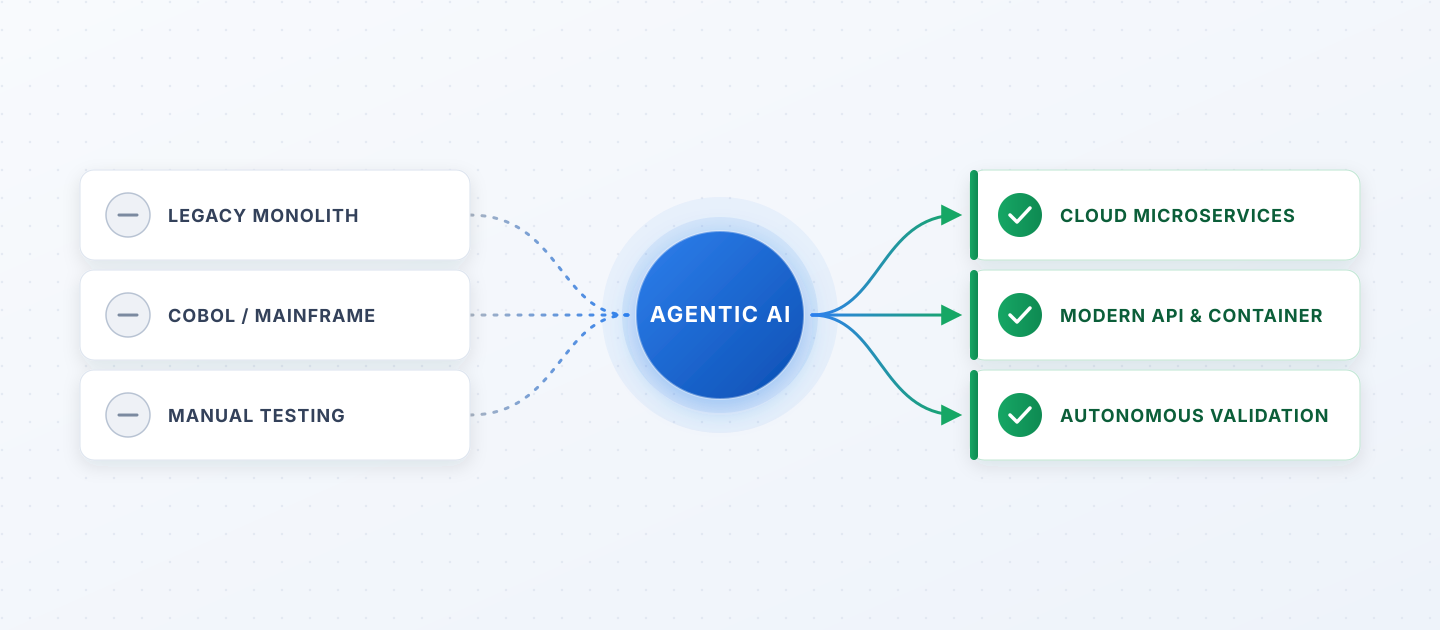
Traditional modernization projects often require manual efforts, from analysing decades-old codebases to validating migrated applications. This process can be time-consuming, especially when organisations deal with complex enterprise environments. Here’s where Agentic AI comes with an effective solution by introducing intelligent agents that can independently execute modernization tasks.
1. Automated Code Discovery and Assessment
Agentic AI agents can scan source code, databases, APIs, and infrastructure environments to develop a detailed inventory of application assets. These agents can easily identify dependencies, map workflows, discover redundant components, and uncover hidden technical debt.
2. Business Logic Extraction and Documentation
Legacy applications contain years of business knowledge embedded directly in the code. Agentic AI can analyze millions of lines of code to discover and document these business rules automatically. Specialized agents work together to understand workflows, data relationships, and application behaviour in a quick span of time.
3. Intelligent Code Refactoring and Migration
In Intelligent Code Refactoring, AI agents evaluate architecture patterns, figure out modernization opportunities, and suggest the most appropriate migration approach (e.g., converting monolithic applications into microservices or modernizing frameworks).
4. Autonomous Testing and Validation
Dedicated testing agents automatically generate scenarios for unit tests, integration tests, regression tests, and performance tests based on the application’s business requirements.
5. Continuous Optimization and Modernization
Agentic AI enables continuous modernization, where AI agents monitor performance, security, scalability, and operational efficiency ongoingly.
Traditional vs. Agentic AI-Powered Modernization
| Traditional Legacy Modernization | Agentic AI-Powered Modernization |
|---|---|
| Documentation is time-consuming. | Document generation is automated. |
| Hidden dependencies discovered later. | AI-powered dependency mapping and early risk detection. |
| Testing and validation performed manually. | AI-assisted test generation and continuous validation. |
| Project estimations are prone to delays and budget overruns. | Cuts project timelines by an estimated 40–50% and accelerates delivery. |
Best Practices for Adopting Agentic AI
- A Clear Modernization Strategy:
Before agentic AI implementation, ensure the purpose of the modernization effort for your organisation. A clear roadmap is required for addressing any technical debt problem and cloud migration, which could help the AI agents prioritize and make
decisions. - Choose the Right Use Cases:
Modernization does not require implementing autonomous AI in every use case. Start by using AI for routine processes such as code analysis, document creation, dependency management, testing, and migration. As the team gains confidence and experience, AI agents can be introduced into complex engineering processes. Trying to understand the different types of AI agents help enterprises choose the right approach at each stage of their modernization journey. - Keep Humans in the Loop:
It is necessary to have human professionals who will be able to verify and evaluate the algorithms and suggest any better ideas for effective performance. - Prioritize Security and Governance: Security is a key thing for a safe AI adoption. Protecting sensitive data requires a combination of encryption and vulnerability testing to protect against threats. These effective measures help protect against malicious actors, prevent unauthorized access,and protect critical business information from breaches that could undermine trust. Furthermore, enterprises must enforce compliance with data privacy and usage regulations to reduce ethical risks while adhering to standards such as GDPR, HIPAA, or industry- specific mandates, depending on the context in which AI operates. Strong compliance practices not only prevent legal penalties but also reassure customers and partners that they handle data responsibly.
Choosing the Right AI Modernization Partner
Here are a few things to look for when comparing with the partners
Legacy System Expertise:
Choose the modernization partner with a background in mainframes, COBOL applications, Natural and Adabas, or ERP platforms for the challenges these environments bring. This would ensure help reduce surprises and keep projects on track.
Company with Clear AI Strategy:
A strong and reliable partner should be able to demonstrate how AI fits into your process—for instance, including analyzing codebases, mapping dependencies, or automated testing—and why these steps matter to an organisation.
Company that understands compliance and regulations:
In highly regulated industries like Banking or healthcare, compliance can’t be left, and a partner who understands compliance requirements such as HIPAA or SOX will know how to build them into the project from the beginning rather than treating them as an afterthought.
Long-term support:
Modernization doesn’t stop the day your new system goes live. Legacy transitions often require ongoing maintenance, updates, and even roadmap planning to stay aligned with business goals. A partner offering long-term support will help your system keep pace instead of falling behind again.

Conclusion
The future of legacy modernization is agentic.The future of legacy modernization will increasingly be defined by intelligent, autonomous systems capable of understanding applications, protecting business logic, generating code, and validating outcomes at scale.
As enterprises continue investing majorly in AI-driven transformation, Agentic AI Legacy modernization will evolve from an emerging capability to a core component of every modernization roadmap.
